Offense
- Loved the hook and ladder on the first possession. The Bears picked that up from Green Bay, who did it to them last week.
- I liked that the Bears got Colston Loveland involved early. I sometimes think that teams outside the division don’t know how important Loveland is to the offense and they don’t do enough to stop him.
- Caleb Williams timing was impeccable coming back after two weeks off with a hamstring injury. I could still wish that his ball placement was better…
- I was listening to a podcast earlier this week and a reporter from Atlanta mentioned that the Falcon defense is different from the Bears. They’re a one gap defense where the defensive linemen just penetrate hard and stop the run on the way to the quarterback. I would guess that’s why we were seeing a number of screens from the Bears offense. The Bears eventually stopped running them, probably because they thought that the Falcons were catching on. But it occurred to me late in the game after some time had gone by that they could have run one or two more for some good yardage.
- The offensive line did a good job both protecting Willams and blocking the run, especially the red zone. The Bears need to be able to run the ball down there.
Defense
- The Falcons have a very well designed run game. Combine that with the prowess of Bijan Robinson and you’ve got quite a potent offense there. The Bears certainly had their hands full, as for the rest of the NFL has had with them so far.
- What’s the difference between Jordan Love and Michael Penix? It’s fourth down in the second quarter and the Bears bring the house. The panic in Michael Penix’s body language is all you need to see.
- Once again, the Bears had to blitz to get pressure on the quarterback. Fortunately, unlike the situation against the Packers, it did occasionally get home. The addition of Kyler Gordon appears to have helped in that aspect. But this is a major issue.
- It sure looks to me like there’s the potential for good offenses to blow the top off of the Bears defense. I just feel like a better quarterback who was better against the blitz would have killed them today.
- I will note, once again, that teams aren’t afraid to go at Jaylon Johnson anymore. He’s not a shut down corner.
- Watching Penix throw the ball it occurred to me. Why don’t we see the back shoulder throw much anymore? It’s practically undependable when it’s done well.
Miscellaneous
- Hey, Tom Rinaldi! Love the suit!
- I thought the special teams units generally came out ready to play. I’m not sure what the numbers will show but most of the time I thought that the Bears started in good field position.
- The muffed punt at the end of the first half was a killer for the Falcons and nice job by Josh Blackwell being right there on the coverage to take advantage.
- I’m starting to lose a little confidence in Cairo Santos with yet another missed field goal. It’s hard to watch after seeing such a nice job done by kickers for the Jaguars and the Texans earlier in the morning.
- Horrendous roughing the punter penalty in the third quarter on Jahdae Walker. Luckily the Falcons went for it on fourth down and didn’t convert it to points. Then you get yourself ejected for a head butt? Man, what are you thinking?
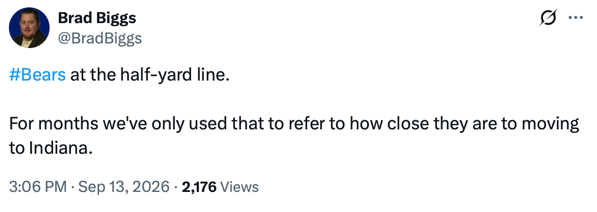
- Appreciate the Bears fanes on the road. But, having said that, tweet of the day from Brad Biggs at the Chicago Tribune:
“Green Bay sucks” chants breaking out as the #Falcons LB Kendal Daniels is immobilized on stretcher.
Maybe not the right time & place?
- My heavens, the penalties! Good heavens, Chicago. What if this had been against an opponent on top of their game?
- I really don’t need to say it, but the turnovers were a disaster for Atlanta. Hard to win that way.
- I appreciate Ben Johnson rewarding some of the special teamers who played so well with some playing time today but it felt a little early, even with a 31-7 lead. Sure enough, the Falcons scored awfully quick immediately afterward. That’s what got the comeback rolling.
- Nice win for the Bears on the road. Williams looked good and that certainly makes a difference. He covers a multitude of sins. The Bears do have a habit of winning games outside the division. I suppose we should be grateful at least that isn’t an issue.